Showing posts with label White Glaze. Show all posts

Friday, March 20, 2015

"Blizzard" Test Tiles

I ended up pushing through the small electric kiln a batch of cups used to test the stability of a new base clear glaze. Its been selected to be used in combination with the studio Crackle and Crawl glaze.

This particular batch is tests using the clear under the Crawl glaze and the effects on varying the thickness of the crawl glaze.


The first example is a medium/heavy thickness application of the base clear glaze under the Crawl glaze. 


Process
Clear base glaze (blue hares fur without oxides)
rim and foot dipped in clear
Interior glazed
body dipped rim down in clear
dried over night
body dipped in crawl


The second example is a much lighter application of the base clear.
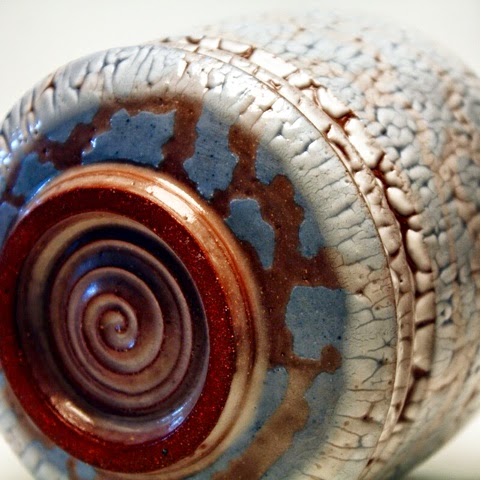


Both worked very well and stabilized the crawl glaze beautifully, but the readability of the cobalt design became more subdued. The results are very nice either way. I need to up the cobalt carbonate and see how brightening up the blue affects the over all design.

Verdict... thumbs up

Friday, April 22, 2011

Orielly White Satin Matt, Cone 10

This is a very satisfying white cone 10 glaze.
Nice and stiff glaze during application, I can build up a nice layered application at the rim and expect it to resolve itself decently. When it's crash cooled, this is a glossy glaze with tooth. Milky crystal formations come with thickness.


56 Custer Feldspar
2  Barium Carbonate
8  Dolomite
10 Whiting
6 EPK
4 Zinc Oxide
3 Petalite
11 Flint
________
6 Zarcopax

This is curtsy of the Val Cushing Handbook.
If you haven't read it.
Find it!

My only hesitation to using this as a liner glaze is due to the Barium Carbonate used in the mix.


"Barium carbonate is widely used in the ceramics industry as an ingredient in glazes. It acts as a flux, a matting and crystallizing agent and combines with certain coloring oxides to produce unique colors not easily attainable by other means. Its use is somewhat controversial since some claim that it can leach from glazes into food and drink. To provide a safe means of use, BaO is often used in fritted form.
In the brick, tile, earthenware and pottery industries barium carbonate is added to clays to precipitate soluble salts (calcium and magnesium sulfates) that cause efflorescence." Wikipedia